Evidence Files
From the Filing Cabinet section of the Walking the Path Reflection Series
Listen or read—whatever fits your pace today.
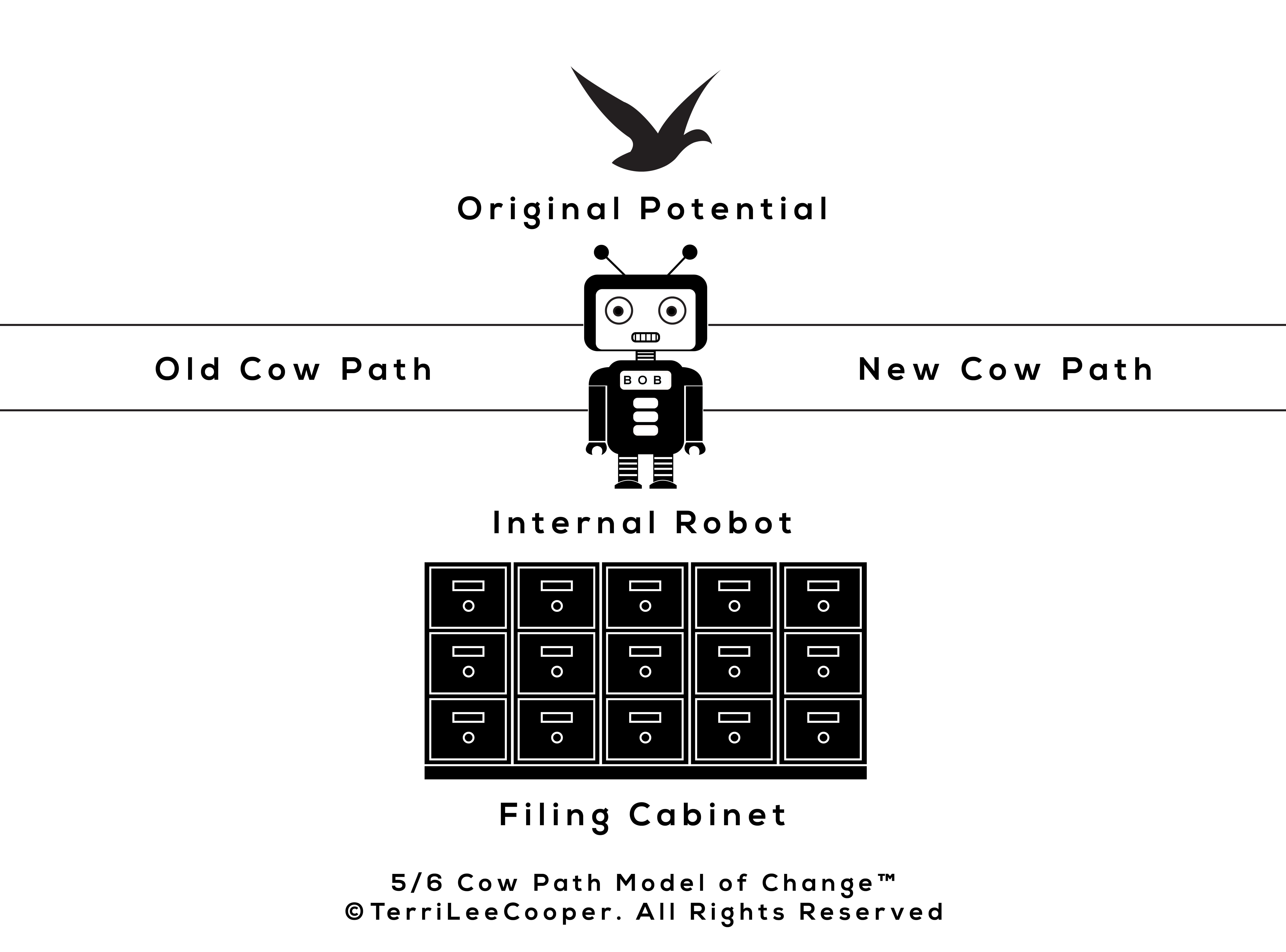
Reflection from the Filing Cabinet phase of the Cow Path Model of Change™.
Sometimes a thought arrives with surprising force. It might be triggered by a small mistake, a difficult moment, or a tired mood. Before we know it, a familiar sentence slides into place: “I always do this" or "I can never get it right.” The thought could even be “Maybe I’m just not good enough.”
In that instant, the mind does something very predictable.
Bob — our Internal Robot — rushes off, not thoughtfully, but reflexively. He pulls open drawers, rummaging through the filing cabinet to gather every example that supports the painful conclusion.
He isn’t trying to hurt us. He simply assumes that whatever we repeat must be important, and whatever feels strongly charged must be true. So he brings forward the harshest evidence first — the moments that stung, the memories that sit close to shame, the echoes of old criticism. They land quickly and convincingly, and suddenly the thought feels justified.
Evidence becomes identity, and identity becomes repetition.
This is how the loop builds itself, one unquestioned moment at a time.
Awareness interrupts the cycle.
Not with force, not with a battle cry, but with clarity: "Wait. I know what this is. This is the robot grabbing whatever is easiest to reach in the filing cabinet."
Bob is automatic, not accurate.
And we don’t have to let this be the whole story. There is a deliberate calm that enters here — a conscious choice to stop allowing Bob to run wild through the archives. Not because we’re scolding him, but because we recognize the cost of letting the automatic mind take the lead.
We realize that peace and possibility require attention, not habit.
In that moment, we remember why we are doing this work.
We want a steadier inner life. We want congruence — to feel aligned with who we sense we can be. We want room to grow, to breathe, to live from a gentler truth. And something in us knows that the chaos Bob dredges up is not in harmony with our deeper nature.
There is a part of us that simply refuses to continue believing that the loudest memories are the truest ones.
That refusal is not rebellion — it is wisdom.
So we pause. We breathe. We look for even one quiet piece of evidence that speaks to a different story: a moment of patience, a time we tried again, a glimpse of resilience or kindness.
These files exist in our filing cabinet— they always have — but they require our deliberate attention to move forward.
Little by little, each moment of conscious recognition reshapes what rises first.
Bob learns through repetition, and every time we choose to focus on balanced, truthful evidence rather than familiar judgment, we teach him something new.
This isn’t about pretending everything is perfect. It’s about refusing to let the loudest memory define the whole self.
Over time, the proof changes — not because we force it, but because we notice it. And as we notice, the filing cabinet grows quieter.
The mind steadies. Identity breathes. The inner world becomes less about defending old conclusions and more about living into new ones.
We don’t need to drown out the old files. We simply need to stop treating them as the only ones that matter.
With awareness, we place our attention — and our trust — where we want our life to grow.
Return to the full Walking the Path Reflection Series curriculum
© Terri Lee Cooper MSc. RSW– Cow Path Model of Change™