Meet Your Internal Robot
Reflection 1/5 Internal Robot
Listen or read—whatever fits your pace today.
Reflection from the Internal Robot phase of the Cow Path Model of Change™.
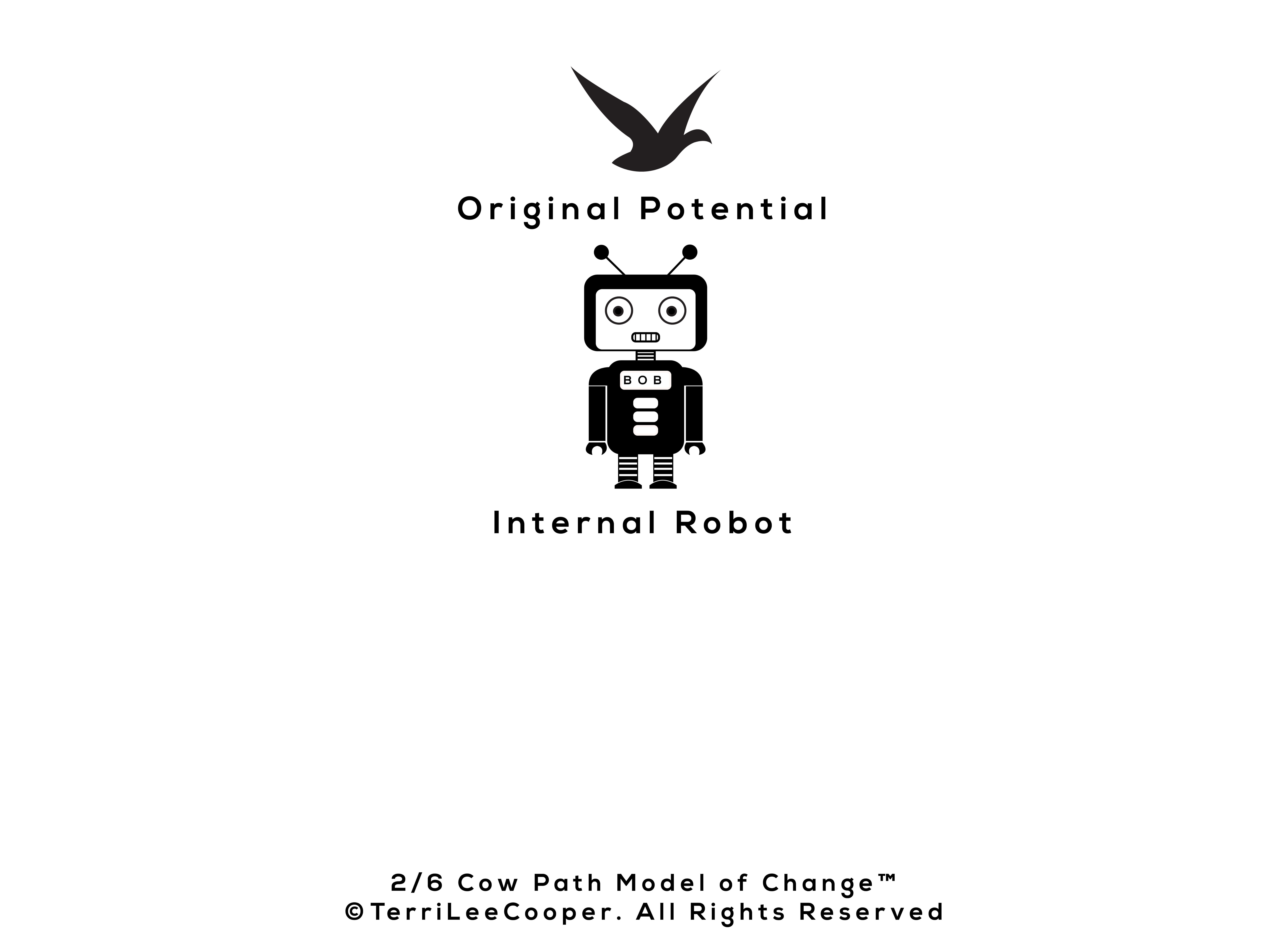
Somewhere inside each of us lives an operator who keeps things running according to plan. It doesn’t sleep, and it doesn’t ask for praise. It simply keeps the system going the way it has always gone.
In the Cow Path Model
of Change™, we call this operator the Internal Robot — known more broadly as
the subconscious mind — that steady, automatic system that works beneath awareness.
During my years in the office I came to name this system "Bob." The
name doesn’t matter so much as the feeling it gives — and the name Bob, was a neutral choice. We demystify this part of us when we give it a shape and a name.
The Internal Robot is the part of us that loves what’s familiar.
It’s the keeper of repetition, the guardian of patterns.
It stores what we’ve done before and plays it back automatically, convinced it’s keeping us safe, and on the straight and narrow. Whether it’s an emotional reaction, a routine, or a thought we’ve thought a thousand times before, the Internal Robot has it filed neatly in our memory banks.
At first, this can be maddening. We want to change, to build new habits, to respond differently, and suddenly — there’s Bob, steering us right back to an old path. We promise ourselves we’ll pause before reacting, and Bob jumps in to us save time. We plan to take a walk instead of scrolling, and Bob reminds us the couch is nearby.
He’s not trying to ruin our progress; he’s trying to
conserve energy. He prefers efficiency. Familiarity
requires less glucose, less uncertainty, less thought, and less planning.
Understanding this makes everything less personal. When we slip into old
behavior, it isn’t failure. It’s simply the Bob, Internal Robot doing its job.
Seeing it this way allows space for humor. The next time we catch ourselves
stuck in a familiar loop, we can smile and say, “Ah, that’s just Bob.” That
tiny phrase softens the moment.
It replaces frustration with awareness — a
signal that we’re beginning to notice the automatic instead of being driven by
it.
The goal at this stage isn’t to fight Bob or reprogram him overnight. It’s to
start a relationship. We begin by observing how he operates, when he steps in,
what situations he guards most fiercely. Sometimes we even admire his loyalty.
He learned our habits and our ways of being faithfully. He remembers every route we’ve ever walked,
even when those paths lead nowhere new, even when our ways of being do not serve us.
Naming and picturing Bob helps externalize this process.
In workshops, people often draw their Internal Robot with a neutral expression — not heroic, not villainous — just quietly determined. The drawing itself becomes a mirror: a reminder that this isn’t an enemy to conquer but a mechanism to understand.
We
can’t influence what we refuse to see.
The Internal Robot belongs beneath the larger light of our Original Potential —
that enduring energy that guides the rest of our personal change. Our potential is
wiser, imaginative, and capable of learning in ways the Internal Robot can’t grasp.
Over time, we’ll teach Bob through repetition and imagination, showing him that new paths can also be safe, and in fact, serve us better. But for now, it’s enough to recognize that he exists and that his stubbornness has a purpose.
This reflection is part of the Walking the Path Reflection Series. View the full Reflection Series Hub.
© 2026 Terri Lee Cooper · Cow Path Model of Change™