"Oh, That’s Just Bob”
From the Internal Robot section of the Walking the Path Reflection Series
Listen or read—whatever fits your pace today.
Reflection from the Internal Robot phase of the Cow Path Model of Change™.
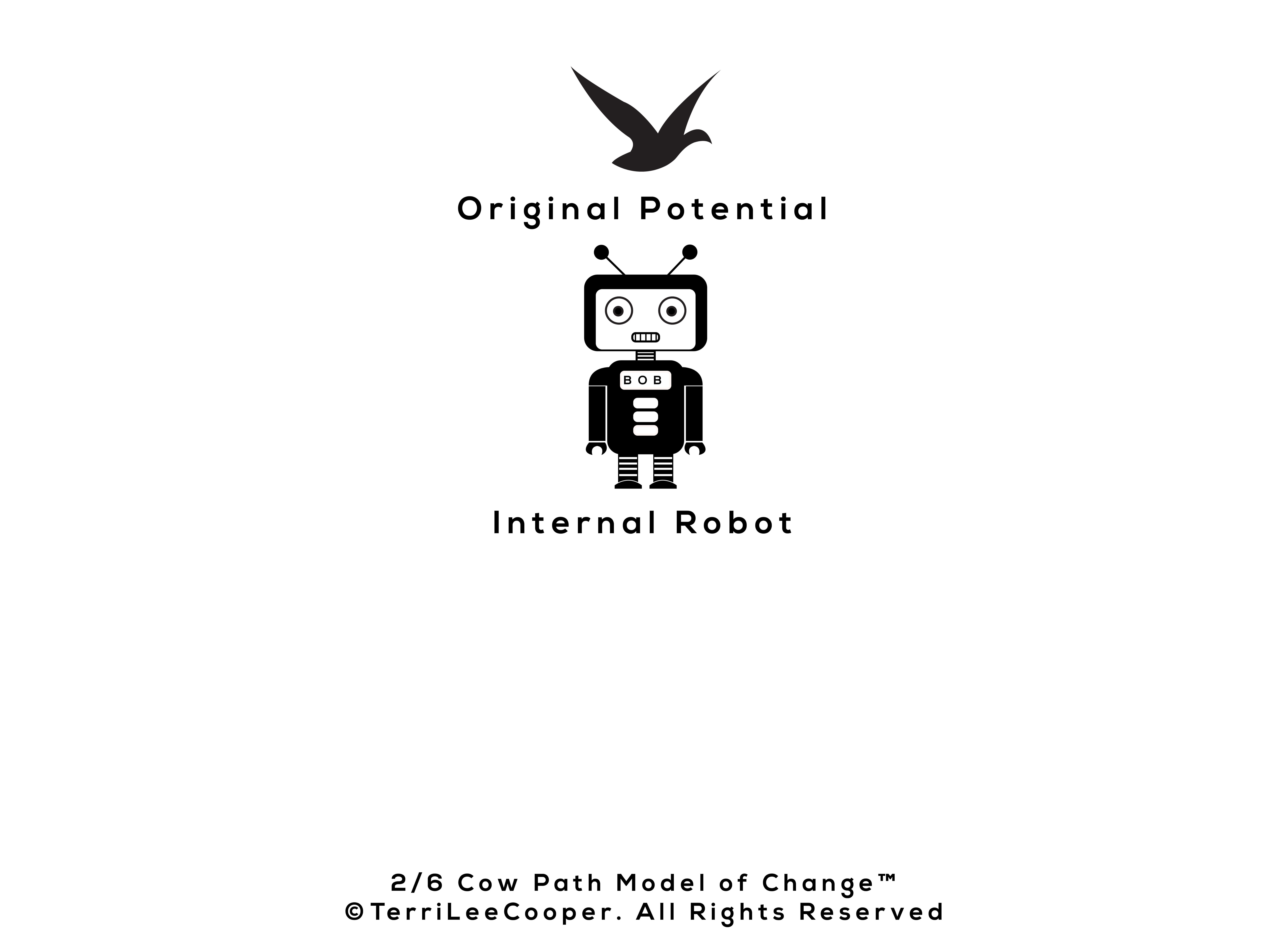
In the last reflections, we began to notice how the Internal Robot, Bob moves quietly through our days—guiding habits, shaping reactions, repeating what feels familiar. We learned to spot him without judgment, to see the automation for what it is. Now, something new happens: we begin to catch him in real time, and instead of tensing or criticizing ourselves, we smile.
That small smile means distance.
It means we are no longer fused with the reaction; we’re observing it. Bob might whisper things like , “Don’t bother—you’ll never finish that,” and rather than collapsing into the script, we breathe and think, “Oh, that’s just Bob.”
Remember Bob has no insight, he is a system that repeats what was once learned. Like any efficient mechanism, he runs the program he’s been given until new data tells him otherwise. His entire purpose is repetition. He loves the status quo.
When we understand that, frustration softens into comprehension.
Awareness often arrives quietly—mid-gesture, mid-sentence, mid-thought.
One moment we’re following the old path; the next we realize, “There it is again—the pattern running.” This pause, this micro-second of seeing, is where self-leadership begins. It’s not glamorous. It’s simply the conscious mind waking up to itself.
At first, we may still wish Bob would vanish.
We imagine enlightenment as the permanent erasure of our automatic responses.
But Bob doesn’t disappear; he updates.
The brain conserves energy by relying on existing pathways. That’s why habits and ways of being feel magnetic—they cost less fuel. Recognizing this is not an excuse to surrender; it’s a reminder that change is biological as well as psychological.
Every new choice demands fresh wiring.
Humor helps keep the work light.
When we say, “Oh, that’s just Bob,” we’re not minimizing the behavior; we’re depersonalizing it. The laughter disarms the shame.
We can see the absurd predictability of our own scripts—how the same phrases, tones, or reactions surface as if summoned by muscle memory. Then, in a quieter voice, awareness adds, “Oh, that’s the pattern running again.” One phrase humanizes the moment; the other defines it.
From there, the practice becomes one of communication and retraining.
We don’t fight Bob; we educate him. We give the mechanism new instructions through repetition, context, and attention. Each time we respond consciously, we’re teaching the system that new patterns are safe to run, and will serve us better in the long run.
It’s patient work—gentle loops of awareness becoming habit in their own right.
Awareness gives us leverage.
This is what it means to develop a relationship with the robotic mind.
Not a relationship in the emotional sense, but of familiarity and fluency. We learn its cues, its rhythms, its learning curve. We speak to it in the language it understands: consistency. Over time, it begins to mirror our intention instead of our history.
And then one day, something small but remarkable happens.
Bob starts his old commentary, and it lands with no weight. We notice, label, and move on. “That’s just Bob. That’s the pattern running again.” Awareness and system coexist, but they no longer compete. The path beneath our feet feels steadier, not because it changed, but because we are now walking it awake. We are conscious.
Each recognition is a quiet act of leadership.
The more fluently we understand the mechanism, the more easily we direct it. And that is the heart of this stage in the journey—the art of walking beside the robotic mind we once followed, guiding it forward with more ease and insight.
Return to the full Walking the Path Reflection Series curriculum
© 2026 Terri Lee Cooper · Cow Path Model of Change™