The Path of Least Resistance
Reflection 2/5 Internal Robot
Listen or read—whatever fits your pace today.
Reflection from the Internal Robot phase of the Cow Path Model of Change™.
We
like to think of ourselves as complex beings, capable of infinite choice. But
under the surface, much of what we do is astonishingly efficient. Our Internal
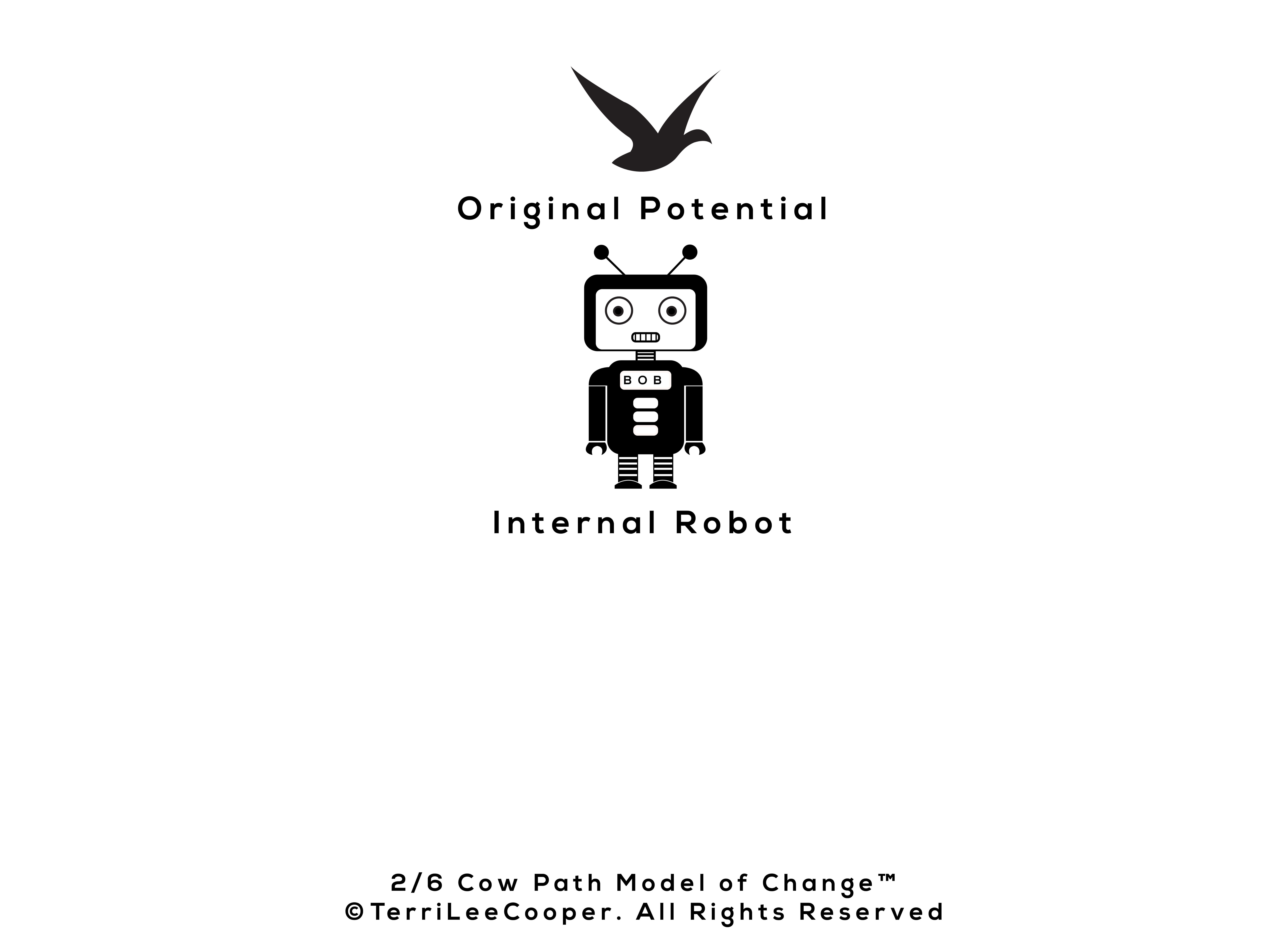
Robot — that quiet operator we met earlier — is devoted to efficiency. It has
one job: keep things running smoothly by using the least possible energy.
This tendency isn’t a flaw. It’s how we’re built. The human brain is an
energy-conserving masterpiece.
Familiar routines require less effort, fewer resources, and almost no conscious thought. Our Internal Robot knows this. Every time we repeat a behavior, think a thought, or feel a familiar feeling, Bob takes note.
He stores the sequence, labels it “works fine,” and adds it to the shortcut menu of daily life.
Over time, those shortcuts harden into well-worn
paths.
That’s the “path of least resistance” — the invisible current that keeps us
doing what we’ve always done. It’s the reason we reach for old habits when
we’re tired, the reason we replay conversations long after they’re over, the
reason we respond automatically before awareness can intervene. Bob isn’t
trying to hold us back. He’s trying to help us save energy.
Still, this devotion to efficiency has a hidden cost.
The more often Bob runs
the same sequence, the narrower our sense of possibility becomes. We stop
noticing alternative routes. We begin to confuse the familiar with the safe.
And before long, what once served us starts to limit us.
It helps to remember that Bob didn’t write the entire manual alone.
The
Internal Robot learned much of what it knows from the world around us — the
family we were born into, the culture we grew up in, the expectations we
absorbed long before we could question them. He took notes on what earned
approval and what didn’t, what felt dangerous and what seemed acceptable. In
his quiet way, he built a database of borrowed patterns and beliefs. Some of it still fits.
Some of it never did.
Realizing this can be an aha moment — gentle but profound.
The patterns that
shape our behavior are not all personal. Many were gifts, or burdens, handed to
us by others. Bob simply stored them, unaware that one day we might outgrow
them. This isn’t a reason for blame or regret. It’s simply a truth about how
humans learn: we inherit instruction before we develop discernment.
So the work of this stage isn’t to scold the Internal Robot for following the
path of least resistance.
It’s to recognize why he does it, and to begin
noticing when that path no longer leads where we may want to go now. Awareness turns
the path of least resistance into a choice, not a trap. Each time we pause long
enough to see Bob at work, we reclaim a little more agency from the automatic.
You can start to notice your own paths this way.
Where do you default to
comfort? When do you find yourself thinking, “this is just what I do”? These
are clues to the paths Bob maintains — not as obstacles, but as evidence of
loyalty. He’s still running the programs that once helped you belong, survive,
or avoid pain. He doesn’t know yet that you have changed.
This is why compassion matters.
The Internal Robot can’t learn through shame;
he learns through gentle repetition. When we meet him with curiosity instead of
judgment, we create the psychological safety that allows change to begin. We
show him that energy spent on growth can be just as efficient as energy spent
on maintenance.
The path of least resistance doesn’t disappear overnight.
But the moment we see
it clearly, we’ve already stepped off it — even if only by a few inches. The
light of Original Potential still shines above us, reminding us that we are not
defined by what’s automatic, but by what’s possible.
So as we move forward, we keep noticing.
We breathe before reacting. We smile when we hear Bob whisper, “this is how we’ve always done it.” And quietly, steadily, we begin to teach him something new: that there are many paths, and some lead closer to who we truly are.
This reflection is part of the Walking the Path Reflection Series. View the full Reflection Series Hub.
© 2026 Terri Lee Cooper · Cow Path Model of Change™