The Landscape of Habit
Reflection 1/5 Old Cow Paths
Listen or read—whatever fits your pace today.
Reflection from the Old Cow Path phase of the Cow Path Model of Change™.
Every
path of awareness eventually turns toward this realization: knowing how the
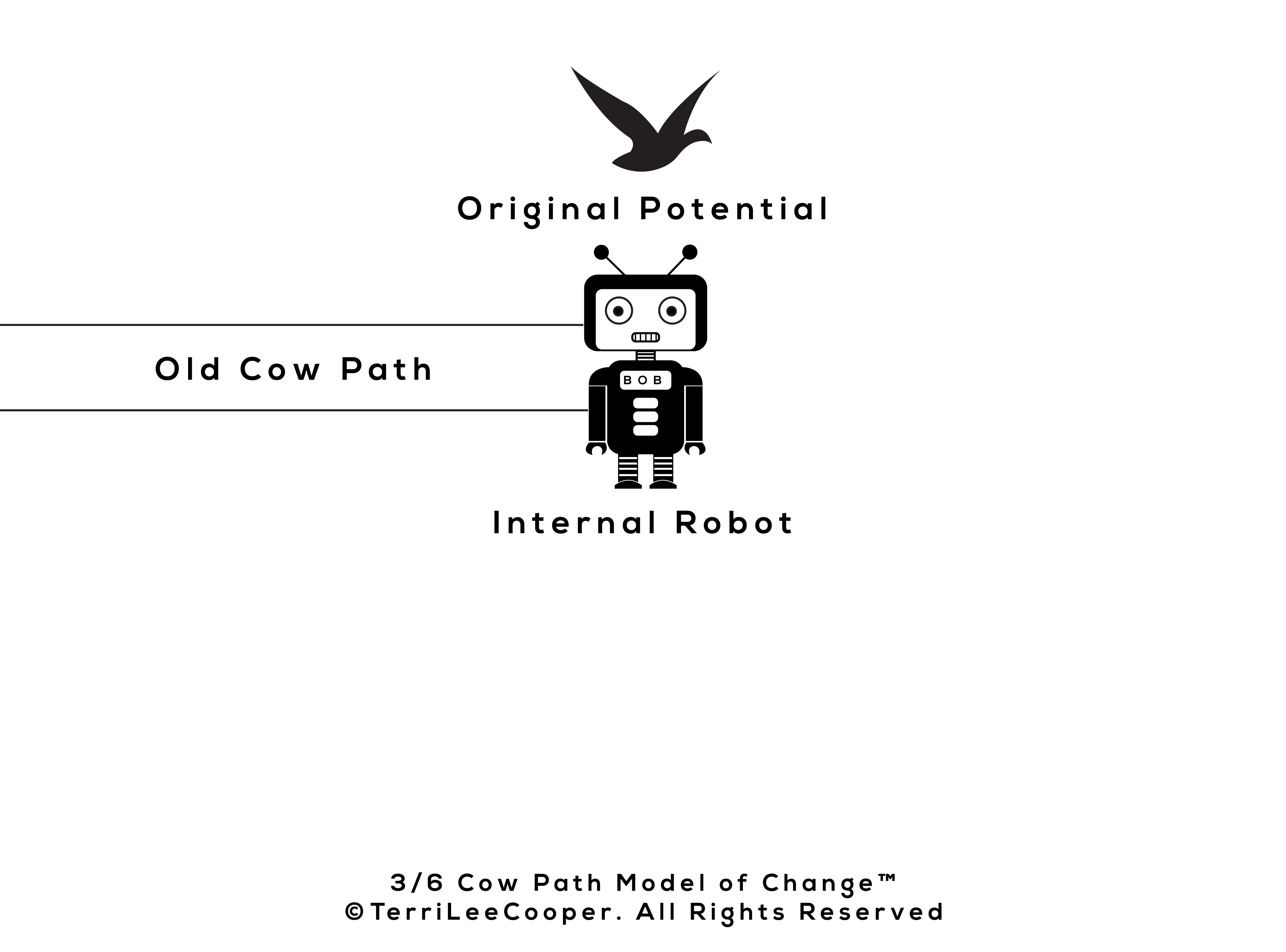
mind works is not the same as living differently. We have met the Internal
Robot; we have seen how he repeats what is familiar. Now we step into the
terrain he has shaped — the landscape of habit.
Here, thought and feeling trace the same loops, worn smooth by years of
repetition.
We follow them almost unconsciously, moving through the grooves of
who we’ve been. These are the old cow paths: the reliable routes of behavior
and emotion that promise safety through sameness.
The truth is, we often prefer familiarity even when it’s painful.
The known ache feels less threatening than the unknown possibility.
Bob continues to run
the programs that match that preference, not because they are wise, but because
they are practiced. His logic is mechanical: repeat what has worked, avoid what
is uncertain.
But the repetition is not only behavioral — it’s personal.
Each well-worn pattern quietly reinforces a version of identity.
The longer we walk the same
path, the more we begin to see ourselves as the person who belongs there. We do
not easily outperform our identity; we live up to the story we believe about
ourselves.
To recognize this is not failure. It’s insight.
When we notice the pull of the
old path, we begin to see the connection between what we do and who we believe
we are. Awareness loosens both. The moment we can ask, "What else is possible
for me?" we are no longer fully confined to the old terrain.
It’s important to remember that not everything on the old cow path needs to be
abandoned.
Many of our long-standing patterns still serve us — the kindnesses, the competencies, the instincts that help us navigate life.
Our work is to
notice which parts continue to support our potential and which restrict
it. Awareness brings discernment; curiosity brings movement. Together they
allow us to sort what to keep from what to release.
We do not erase the old cow paths by force; we outgrow them through awareness.
Each time we pause long enough to see the pattern, the edges of identity begin to soften.
The question, "What else is possible for me?" is not a demand for
change but an invitation for expansion — a quiet reminder that identity itself
can be renewed. The path doesn’t vanish; it simply stops being the only one we
see.
Change begins here — in the instant we realize that the familiar path is not a
border, only a memory. Each question, each small widening of perception,
becomes a step toward new ground.
These cow paths symbolize our ways of being — the intertwined thoughts, feelings, and behaviors that have become automatic over time. They form the invisible framework through which we perceive both the world and ourselves. Some of these ways of being still serve our potential; others limit it and do not serve us.
Awareness begins when we can tell the difference between what helps us live and what simply keeps us the same.
This reflection is part of the Walking the Path Reflection Series. View the full Reflection Series Hub.