The Mind’s Archive
Reflection 1/5 Filing Cabinet
Listen or read—whatever fits your pace today.
Reflection from the Filing Cabinet phase of the Cow Path Model of Change™.
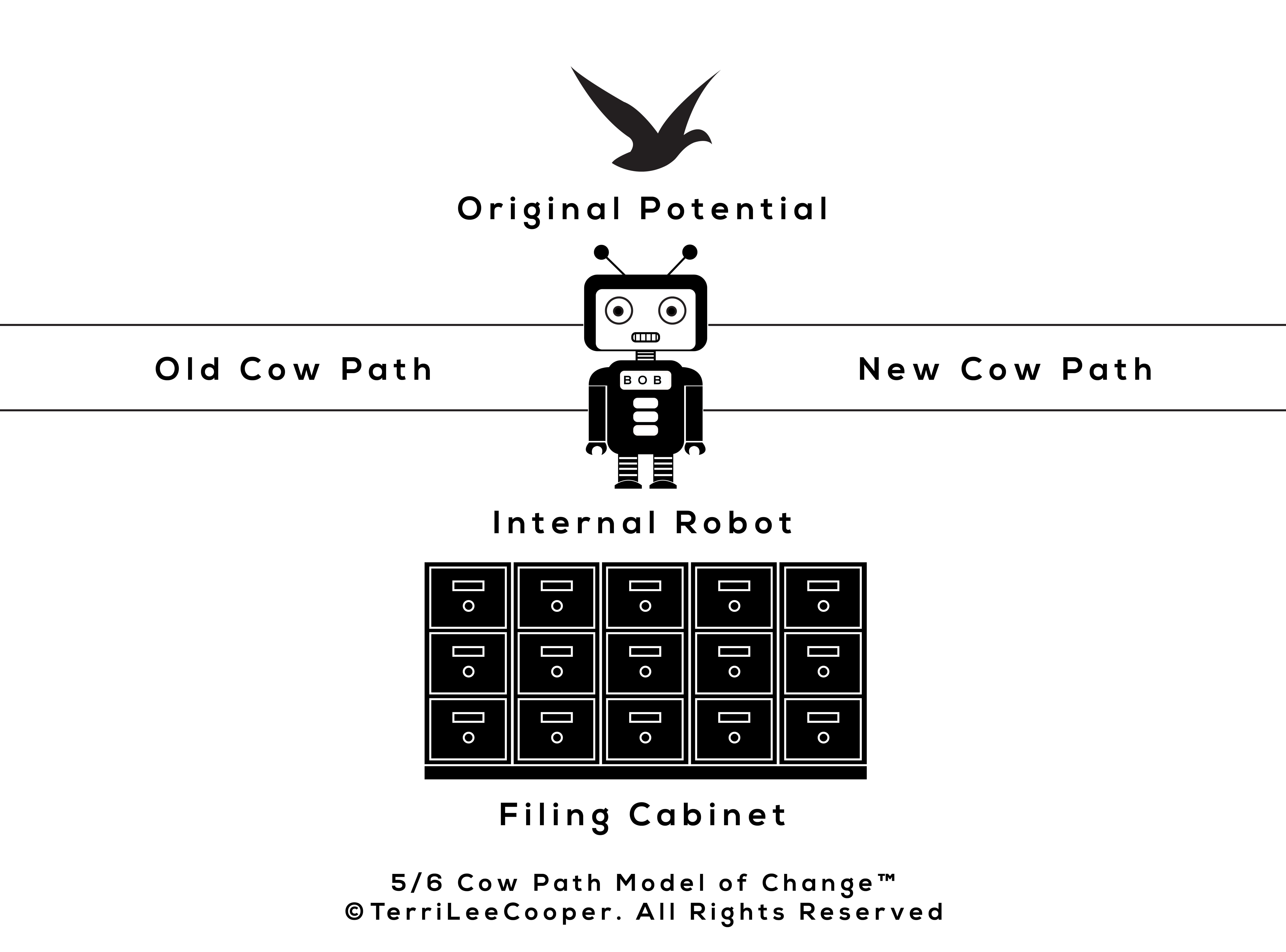
There is a quiet place within each of us — an invisible archive where our lives are stored. Every sight, sound, conversation, and emotion leaves its trace there. We might call it memory, but it’s more than that. It is the ongoing story of how we have come to know ourselves.
Most of us don’t think about our filing cabinet until something inside it gets stirred.
A smell, a phrase, a familiar tone of voice — and suddenly an old file slides forward. Without our permission, the memory plays again: the thought, the feeling, the conclusion about who we were in that moment.
The mind, ever efficient, keeps what it believes will be useful. Over time, those well-used files become the foundation of our self-image.
Bob, our Internal Robot, is the devoted librarian of this archive.
He’s not philosophical; he’s practical. His job is to find the quickest match to whatever situation we face. If a moment feels familiar, he reaches for the nearest file and hands it over. “Here,” he says without words, “this is who we were last time.”
He assumes repetition equals reliability. It never occurs to him that we might have grown.
Awareness begins when we start to notice this exchange.
We realize that our sense of identity — the quiet narrative running beneath our days — is often built from a limited selection of files. A few vivid experiences at the front of the cabinet begin to stand in for the whole story of who we are.
We start to confuse the familiar with the complete. But the archive is vast.
Behind the most dog-eared folders lie records of courage, creativity, tenderness, and patience. They’ve simply been tucked too far back to reach easily. When we pause long enough to become curious, those forgotten parts of ourselves begin to shuffle forward.
They remind us that identity is not a verdict; it is an arrangement — one that can be gently reordered.
Re-filing begins with attention.
Each time we dwell on what affirms our growth — a kind choice, a moment of resilience, a quiet success — that file moves closer to the front.
The brain takes note: this matters now. And just like that, our self-perception starts to shift.
We become a little less defined by what once hurt us and a little more shaped by what now sustains us. The practice is not about erasing the past. Those old files still belong to us; they simply don’t need to dominate the view.
With awareness, we can hold them lightly — grateful for what they taught us, no longer bound by their version of who we had to be. The act of seeing them clearly, without judgment, is itself a reorganization.
Imagine sitting quietly inside your own mind’s library.
The drawers open smoothly. You can feel the weight of what’s there — familiar, layered, alive. And somewhere near the back, a small light flickers on a folder you haven’t touched in years. You reach for it, read the truth it holds, and decide it deserves a place closer to the front of your filing cabinet.
That is the essence of this work: becoming the curator of your own identity.
The filing cabinet will always contain multitudes — joy and sorrow, failure and growth — but awareness allows us to choose which stories we live from.
Each new act of noticing is a gentle reshuffling toward wholeness. And in that movement, something remarkable happens. The past doesn’t vanish; it integrates. The self doesn’t reinvent; it expands. The archive breathes again, and with it, so do we.
This reflection is part of the Walking the Path Reflection Series. View the full Reflection Series Hub.