Walking with Awareness
Reflection 5/5 Internal Robot
Listen or read—whatever fits your pace today.
Reflection from the Internal Robot phase of the Cow Path Model of Change™.
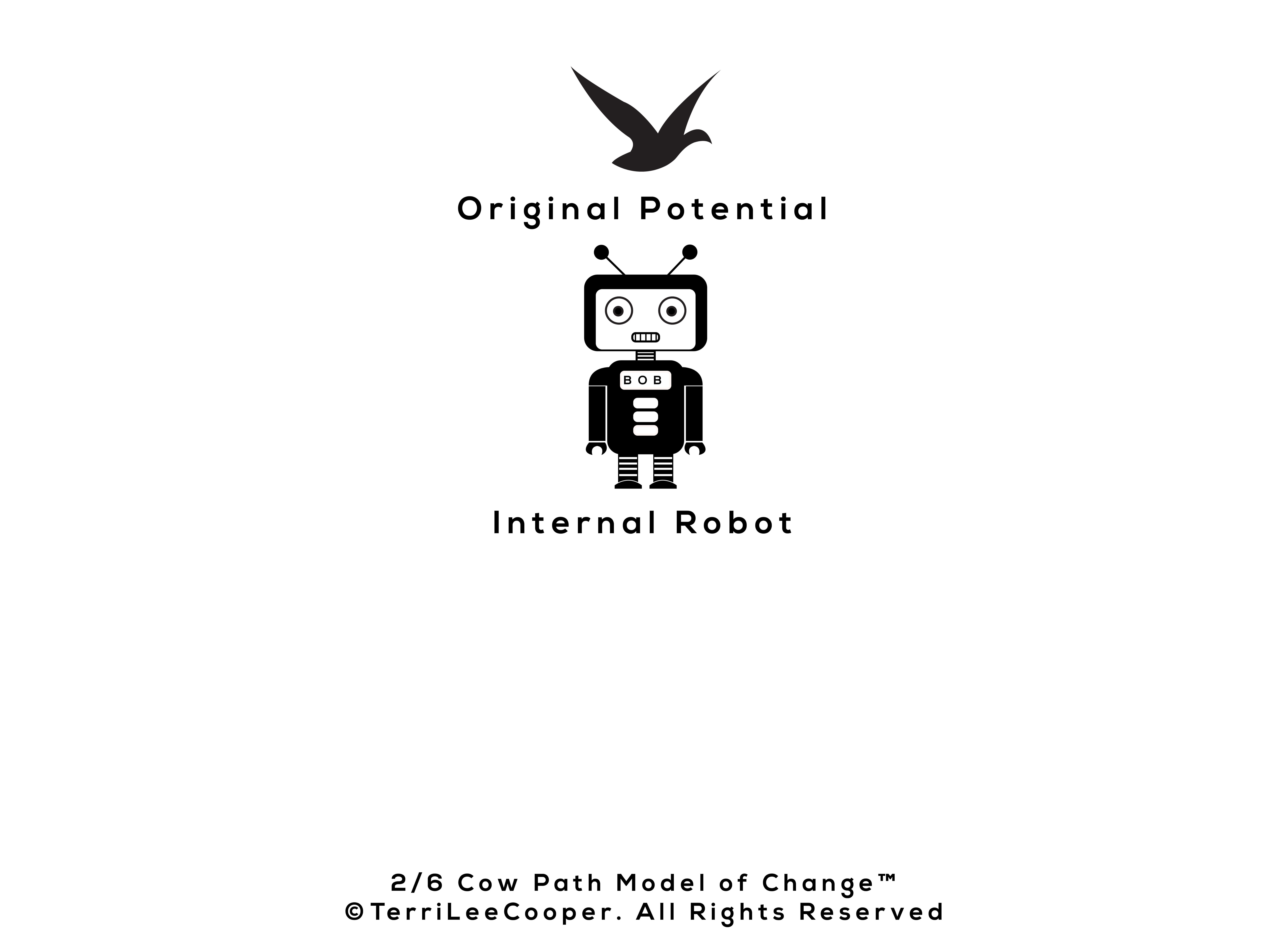
In the earlier parts of this series, we met the Internal Robot—the automatic system that repeats what it has learned—and we discovered that naming it “Bob” helps us notice it without judgment. By now, we’ve seen Bob appear in all kinds of moments: the hesitation before speaking up, the familiar tone of self-doubt, the instant reaction that arrives before thought. We’ve learned to recognize him, smile, and say, “Oh, that’s just Bob. That’s the pattern running again.”
Now we begin to understand something deeper: awareness is not a destination we reach once and hold.
It is a state that must be remembered again and again.
Even after years of practice, the Internal Robot continues to hum in the background, doing what robots do—repeating. The difference is that each time we remember, we step out of the trance a little faster. Each return to awareness is a small act of personal leadership.
Most of us
believe we’re already aware simply because we’re conscious, but the Internal Robot can mimic consciousness perfectly. It can mimic sounding wise. That’s mechanical, not true awareness.
Real awareness is deliberate.
It’s the act of noticing the pattern while it’s running, and choosing to stay awake.
When the robot leads, we move through life on autopilot—reacting, explaining, defending. When we lead, we act deliberately: we pause, we breathe, we choose. That moment of deliberation is the spark of self-leadership.
It’s how we move from being lived by our patterns to living as the one who guides them.
Early awareness is sudden—like catching a glimpse of our own reflection in a shop window.
Mature awareness feels quieter; it’s the way we walk once we’ve accepted the reflection as part of the landscape.
We still forget. We still drift. But the remembering comes more gently, and without blame. At first, awareness is a flicker. With practice, it becomes a lamp we carry, lighting only the few steps ahead yet enough to keep us moving.
The robot doesn’t evolve on its own timetable; it updates when our attention repeats a new instruction often enough. That takes time, and sometimes years. Many people mistake early insight for final change and grow discouraged when the old patterns return. But that return is not failure—it’s evidence that the system is still active, waiting for new data.
We can’t rush a mind built on repetition; we can only meet it with steadiness and compassion.
This is why self-kindness matters so deeply.
Working with the Internal Robot can feel like teaching a child or programming a machine that forgets overnight what it learned yesterday. It’s tiring work, but it’s honest work. Awareness matures not through brilliance but through patience—the willingness to begin again, often.
And then something subtle happens. As we grow more familiar with our own automation, we start to notice that everyone else has an Internal Robot too. Every person we meet carries their own automatic mechanism: a pattern of reactions, a catalogue of defenses, a collection of well-worn responses built to keep them safe.
Most people don’t know they have one.
They’re speaking through it, acting through it, trusting it to guide them the same way we once trusted ours.
Seeing this doesn’t make us superior; it makes us gentler.
When someone interrupts, withdraws, or overreacts, we begin to wonder—not in judgment, but in curiosity—whether we’re hearing their conscious voice or their Internal Robot running an old script. This understanding can soften even difficult interactions. We pause more often. We assume less. We take things less personally. We recognize that behind every pattern is a person, and behind every person a mechanism still learning how to update.
We can’t fix anyone else’s Internal Robot, and it isn’t our job to try.
But knowing that everyone has one helps us navigate the world with more empathy and less urgency. It reminds us that humanity is a shared project of waking up—each of us at our own pace, each with our own code to rewrite.
As we close this part of the journey, the Internal Robot remains beside us, steady and predictable. Awareness walks with it, not against it. Every recognition—every “That’s just Bob”—is a small widening of consciousness. And when we look up from our own path, we see that others are walking too, each guided by their own unseen mechanism, each capable of awakening to it in time.
The path we walk together grows softer through understanding. We meet the Internal Robot. We name it. We notice the pattern. We smile. And we walk on.
And as awareness deepens, we begin to notice that our patterns are not only about what we do, but about who we believe ourselves to be. This is where the next chapter opens — the old cow paths.
This reflection is part of the Walking the Path Reflection Series. View the full Reflection Series Hub.