Ways of Being
Reflection 2/5 Old Cow Paths
Listen or read—whatever fits your pace today.
Reflection from the Old Cow Paths phase of the Cow Path Model of Change™.
When
we first notice the old cow paths, we might see them only as habits — familiar
routines of thought and behavior that keep us moving along predictable routes.
But when we look closer, we discover something deeper. The old cow path is not just about what we do; it represents who we have learned to be. It symbolizes our ways of
being — the patterns of thought, feeling, and behavior that have become so
practiced that they now move on their own.
A way of being is not a single reaction or choice.
It is the atmosphere of our inner world — the tone and rhythm of how we live.
It shapes how we interpret what happens, how we respond, how we treat ourselves, and what we believe we deserve.
These ways of being began forming early, often as practical responses
to what life required of us. They were our best attempts to stay safe, to
belong, and to manage uncertainty. Over time, repetition turned them into identity.
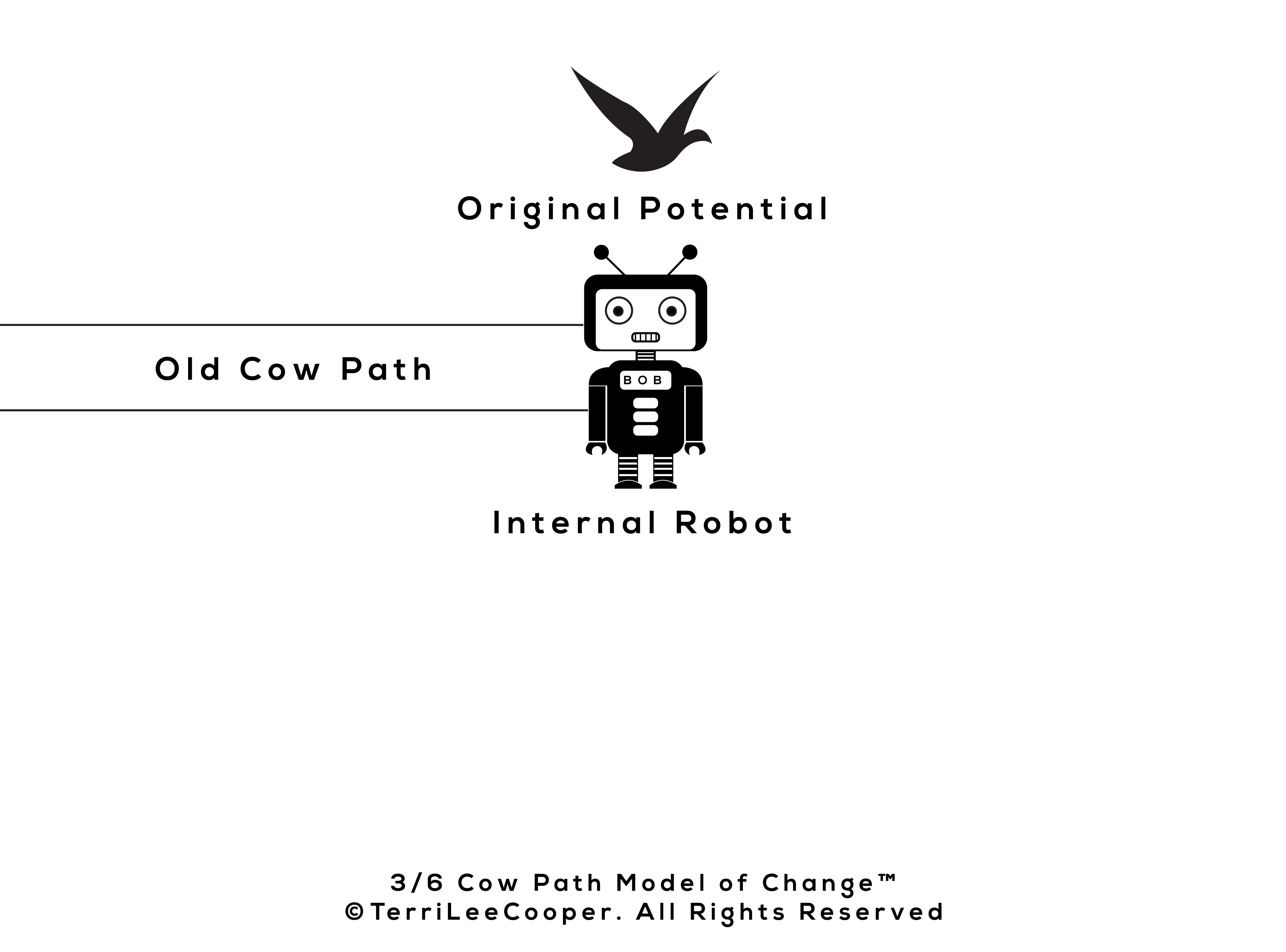
Bob, the Internal Robot, plays a large role in this. Once he learns a pattern,
he prefers to keep running it. He doesn’t pause to ask whether it still serves
us. He doesn’t weigh intention or meaning. He simply repeats what has worked
before. Each repetition presses the path a little deeper, until the route
itself begins to feel inevitable — not a pattern we’re following, but the person
we are.
That’s the quiet transformation most people never notice.
The repetition of thoughts and emotions begins to sculpt the sense of self. When we feel anxious often enough, we start to see ourselves as anxious. When we hold back long enough, we start to believe we are cautious or shy. The way we move becomes the way we define ourselves.
It’s easy to forget that these are only patterns —
once-learned ways of being — not fixed truths about who we are.
Every old cow path contains both wisdom and limitation.
Some ways of being still
serve us beautifully: the patience that steadies us, the reliability that
builds trust, the kindness that keeps us connected. Others quietly narrow our
world, repeating stories that no longer fit the life we wish to grow into. Awareness isn’t about judging these patterns; it’s about seeing them clearly
enough to tell the difference.
This is why awareness feels both powerful and unsettling.
It reveals the quiet
machinery beneath personality — the realization that who we’ve believed
ourselves to be is, at least in part, a learned response. The moment we
glimpse this truth, we also glimpse possibility. If these ways of being were
learned, then they can also evolve.
For now, the task is simple: to see the pattern for what it is.
To recognize
the feeling of repetition as evidence of learning, not failure. Each time we
notice an old response surfacing, we are standing a little apart from it. We
are no longer entirely inside the rut.
The cow path, then, is more than a metaphor. It’s a living record of how our
history, emotions, and choices have converged to shape our present identity. It
reminds us that much of what feels automatic was once intentional, and that
awareness itself is the beginning of something new.
We remain on familiar ground, but the view has changed. We’re not yet creating
new paths — that will come later — but we are beginning to understand the one
beneath our feet. Awareness allows us to walk it with open eyes.
This reflection is part of the Walking the Path Reflection Series. View the full Reflection Series Hub.